The Starting Point: A Familiar Challenge in Schools
Over the years, I’ve worked on many installations in educational environments, and they often share the same issues:- Projectors that struggle in bright rooms
- Low contrast during performances
- Maintenance-heavy systems
- Limited flexibility for modern presentations
Designing the Solution: Two High-Definition LED Displays
For this project, we installed two LED displays, each measuring 10 by 6 feet, using a 2.5mm pixel pitch. For those who are not deep into technical specs, I usually explain it like this: the smaller the pixel pitch, the sharper the image looks when you stand close. In this case, 2.5mm gives us a very crisp, detailed image that works perfectly for both performances and presentations in a college environment. The result is a display that stays bright, clear, and consistent regardless of lighting conditions in the room. This is also where clients often start comparing options like a led wall for sale, because they realize they’re not just buying a screen—they’re investing in a long-term visual infrastructure.Installation Day: Concrete Walls and Real-World Conditions
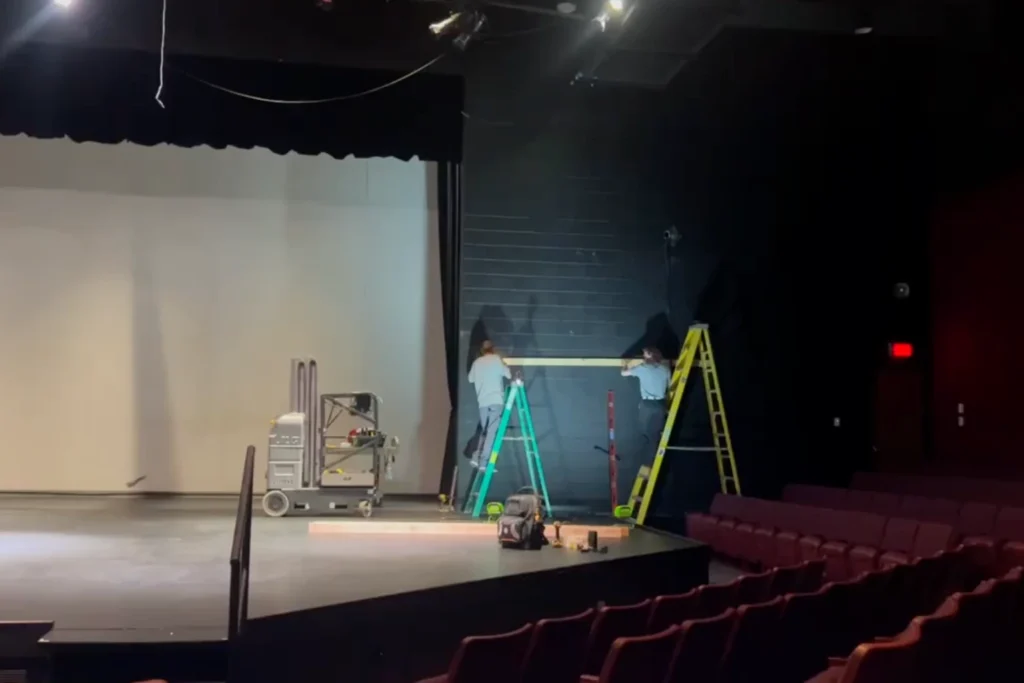
One thing I always tell people is that no two installations are ever the same. At Joliet Junior College, we mounted both LED displays directly onto a concrete block wall. That sounds straightforward, but in reality, concrete installations require precise planning, alignment, and structural consideration. We used a hybrid installation approach:- Part of the work was handled by college maintenance staff
- The rest was executed by our onsite LED technician team
Time Pressure: A 3-Day Installation Window
One of the key challenges of this project was the timeline. We had to complete the entire installation during spring break—just a 3-day window. In college environments, you rarely get more time than that without disrupting classes or events. So everything had to be carefully planned:- Delivery coordination
- Mounting structure preparation
- Panel installation
- System calibration
Unexpected Issue: Damaged Panel During Shipping
Even with perfect planning, real-world logistics can always introduce surprises. During this project, one LED panel was damaged in transit. This is something that can easily delay a project if not handled properly. But in our case, we immediately coordinated an express replacement while continuing with the rest of the installation. This is where experience matters. You don’t stop the project—you adapt, reorganize, and keep moving forward. By the time the replacement arrived, everything was already aligned and ready for final integration. This is also one reason institutions often prefer working with experienced teams like Canadian LED, because they know issues will be handled quickly without affecting deadlines.Final Result: A Modern, Engaging Learning Environment
Once the system was fully installed and calibrated, the transformation was immediate. The difference between the old projection system and the new LED displays was not subtle—it was dramatic. The space now supports:- Theatre performances with vivid visuals
- Clear, bright presentations in any lighting
- Engaging content for students and visitors
- A more modern institutional image
Why This Upgrade Matters for Educational Institutions
When schools invest in modern display systems, they’re not just upgrading technology—they’re upgrading communication. In my experience, institutions choose LED systems because they want:- Reliability
- Brightness in all conditions
- Low maintenance
- Long-term performance
Practical Insights from the Field
Every installation teaches me something new, but a few key lessons always repeat:- Planning is everything The success of a 3-day install depends on preparation weeks in advance.
- Flexibility saves timelines Having a hybrid team allowed us to move faster and adapt on-site.
- Logistics can make or break a project Shipping issues are normal—response time defines success.
- Education spaces need durability, not just visuals Schools use systems daily, so reliability is critical.
A Broader Perspective on LED Projects
Working across different environments—from colleges to corporate venues—I’ve seen how LED technology continues to evolve. Institutions often start researching options like a led wall for sale, comparing specs and suppliers, but what really matters is how the system performs in real conditions. That’s why our approach focuses not just on equipment, but on full installation execution and long-term usability. At Canadian LED, we always aim to deliver systems that feel seamless for the end user—whether it’s a small classroom upgrade or a full performance hall installation.