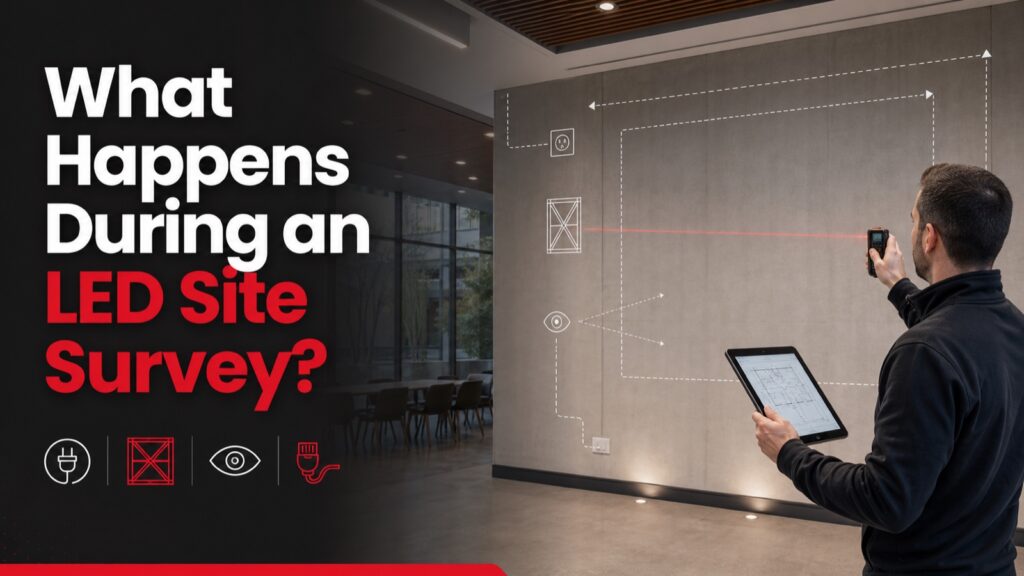
Short answer: an LED site survey is the on-location fact-finding step that turns a display idea into a buildable scope. A qualified integrator measures the space, checks structure, power, data routes, access, sightlines, ambient light and operating requirements, then documents the conditions that affect screen size, pixel pitch, mounting, budget and schedule.
For a Canadian business, school, worship facility, recreation centre or public venue, the survey is where assumptions are replaced with evidence. It is not a sales walkthrough and it is more than taking the width of a wall. The goal is to identify technical constraints early enough to design around them—before equipment is ordered or construction begins.
Why an LED video wall site survey matters
Direct-view LED systems are modular, but that does not make every wall equally suitable. Cabinet dimensions, service access, electrical load, heat, cable length, viewing distance and the building’s structure all influence the final design. A survey also clarifies who is responsible for electrical work, engineering, permits, finishes, lifts, network access and content sources.
AVIXA’s video-wall planning guidance highlights physical space, lighting, mounting and electrical capacity as core design considerations. Its current site-survey guidance similarly recommends documenting dimensions, surfaces, cable paths, power, obstacles, viewing conditions and site photos rather than relying on memory.
What happens before the site visit?
A useful survey starts with a short discovery conversation. The integrator should understand what the display must accomplish, who will view it, what content will run, when the space is available and what budget or schedule constraints already exist.
Expect questions such as:
- Is the display permanent, mobile or used for occasional events?
- What is the closest and typical viewing distance?
- Will viewers read fine text, watch video, follow scores or see presentation content?
- What source equipment, cameras, computers or content-management system will feed the wall?
- Who controls the screen, and where should that equipment live?
- Are there renovation dates, public events or restricted work hours?
If drawings, wall sections, electrical schedules or reflected ceiling plans exist, sharing them before the visit helps the surveyor focus on items that must be verified in person.
What gets inspected during an LED site survey?
1. Wall dimensions and mounting conditions
The surveyor records available width, height and depth—not just the desired picture size. They check whether the wall is level and plumb, note material and finishes, locate columns or framing where possible, and identify obstructions such as millwork, speakers, sprinklers, lights, doors and HVAC components.
A visual inspection cannot certify structural capacity. If the display or mounting system creates loads that require engineering, the integrator should identify that need and coordinate with a qualified structural professional. The survey’s job is to flag the condition, capture relevant information and prevent the proposal from being based on an unverified wall.
2. Viewing distance, sightlines and ambient light
The team checks where the audience stands or sits, the closest viewer, viewing angles and any locations where architecture or equipment blocks the image. These observations help determine appropriate screen dimensions and pixel pitch. A smaller pixel pitch can support close viewing and detailed content, but the best choice should match the real audience and use case rather than a specification chosen in isolation.
Windows, skylights, stage lighting and direct sun are documented because brightness requirements change with the environment. Photographs from key viewing positions are valuable for design review and client approval.
3. Electrical capacity and power distribution
An LED wall can draw a meaningful electrical load. The survey records the nearest panels, existing receptacles, available circuits and potential routes to the display and control equipment. Final circuit design and electrical work must be completed by qualified trades in accordance with applicable codes and the approved equipment schedule.
The design should consider both maximum demand and typical operation, distribution across the wall, grounding, surge protection and shutdown access. “There is an outlet nearby” is not a complete power plan.
4. Signal, data and control pathways
The survey maps how video and network signals will travel from sources and controllers to the LED wall. Cable type, distance, bend radius, pathway capacity and separation from power can affect the design. The team also determines where processors, media players, network switches and operator controls can be installed with adequate ventilation and service access.
If the screen will support live production or venue events, discuss camera feeds, presentation switching, audio integration, latency and backup sources. For a simpler digital-signage application, the key questions may be network availability, remote management and who publishes content.
5. Installation access and work-site logistics
Installers need a safe path from delivery vehicle to final wall. The survey checks loading areas, door and elevator dimensions, stairways, floor protection, lift access, ceiling height, staging space and building occupancy. It should also identify restricted hours, security procedures, dust controls and whether work must be phased around the organization’s operations.
These details directly affect labour and schedule. A display that is simple to assemble at floor level may require a different plan when it must pass through narrow corridors or be installed above fixed seating.
6. Service access and long-term operation
A wall must be maintainable after opening day. The survey helps confirm front- or rear-service access, clearance for module removal, the location of spare parts and a practical route to processors and electrical disconnects. It also uncovers training needs: who starts the system, changes content, troubleshoots sources and contacts support?
What should you receive after the survey?
The exact deliverables depend on project stage, but a professional survey should support a clear written scope. That may include annotated photos, verified dimensions, a preliminary screen size and location, mounting concept, power and data requirements, access notes, responsibilities, exclusions and issues requiring engineering or trade confirmation.
A strong proposal distinguishes verified facts from pending items. For example, it may state that the wall dimensions were measured while structural capacity remains subject to an engineer, or that an electrical contractor must confirm spare breaker capacity. This makes comparisons between proposals more meaningful and reduces costly scope gaps.
How long does an LED site survey take?
A straightforward room may take roughly one to two hours on site. Large venues, outdoor locations, complex renovations or projects with several display locations can take half a day or longer. The visit is only part of the work: reviewing drawings, organizing photographs, calculating loads and preparing recommendations happens afterward.
Power, structure, access and finishing work all fit into site readiness. If your project is still comparing permanent and temporary approaches, review Canadian LED’s LED screen rental options, browse the project gallery, or learn more about our indoor LED screen solutions for practical context.
How to prepare for your survey
- Invite the facilities contact and the person responsible for content or events.
- Provide available architectural, structural and electrical drawings.
- Clear access to the proposed wall, electrical rooms and control locations.
- List the source devices and workflows the display must support.
- Share renovation plans, fixed deadlines and restricted working hours.
- Identify who can approve dimensions, finishes and construction responsibilities.
Do not worry if every answer is not available. The purpose of the visit is to discover unknowns. What matters is recording them and assigning a clear next step.
Turn your LED wall idea into a buildable plan
A disciplined site survey protects the buyer as much as the installer. It creates a common factual basis for design, budgeting and coordination while there is still time to solve problems efficiently.
Planning a permanent LED video wall or a temporary installation in Alberta? Contact Canadian LED to discuss your space, audience and project goals and arrange the right next step.
Frequently asked questions
What is an LED site survey?
An LED site survey is an on-location assessment of the space, structure, power, signal routes, viewing conditions, access and operating requirements for a proposed LED display. It replaces early assumptions with documented project facts.
Do I need a site survey before getting an LED wall quote?
A preliminary budget can often be discussed before a visit, but a site survey is normally needed for a reliable installation scope. It identifies conditions that can change the equipment, mounting, electrical work, labour and schedule.
How long does an LED video wall site survey take?
A straightforward single-room survey may take one to two hours on site. Large venues, multiple display locations, outdoor projects or renovation coordination can require half a day or longer, plus follow-up design work.
Who should attend the site survey?
The facilities or building contact should attend, along with the person responsible for content, events or daily operation. For complex projects, the general contractor, electrician, structural engineer or IT representative may also need to participate.
Does the site survey include structural engineering?
Not automatically. A survey can document the wall and flag potential structural requirements, but certification and stamped designs must come from a qualified structural professional when required by the project and local authorities.
What should I have ready before the survey?
Provide any available drawings, access to the proposed wall and electrical areas, a list of content sources, viewing requirements, schedule constraints and the names of people who can answer facilities and operational questions.